Painless Mouth Swab Detects Oral Cancer in One Hour
A new brush swab test detects oral cancer with 95.5% accuracy in under an hour, offering a painless alternative to surgical biopsies.
Oral cancer might not be one that many people think to look out for, but its prevalence is rising and it can be deadly.
As with many cancers, catching it early is key to the best outcomes — but diagnosis is tricky and invasive.
Now, scientists from the UK and India have demonstrated an effective and non-invasive new kind of test that can accurately detect the presence of cancer in the early stages. Best of all, the results are in within an hour.
“[This test] gives clinicians a rapid, accurate, and non-invasive way to triage patients, and crucially, it can be repeated,” says Muy-Teck Teh, an oral oncologist at Queen Mary University of London.
“That means we can now monitor patients with persistent pre-malignant lesions regularly and systematically — and pick up cancers much earlier than we would have been able to before.”
The Problem With Current Diagnosis
Oral cancers usually manifest as persistent sores or discolored patches on the lips, gums, tongue, or inner cheeks.
Many of these are benign, but it pays to check. Unfortunately, checking usually involves taking a biopsy of the affected tissue with a scalpel, which can be painful in such a sensitive part of the body.
Worse still, multiple biopsies can be needed over time to monitor how a benign lesion might progress into cancer. But because it’s so invasive, many patients opt out of follow-ups.
How the New Test Works
Thankfully, there could soon be a painless alternative. Scientists have tested a new diagnostic tool that requires nothing more than a quick brush of the mouth.
The quantitative Malignancy Index Diagnostic System (qMIDS) involves using a brush to swab the suspect lesion, then analyzing it for signs of mRNA expression from four specific genes linked to oral cancer. At the same time, a control sample, swabbed from an unaffected part of the mouth, is also analyzed.
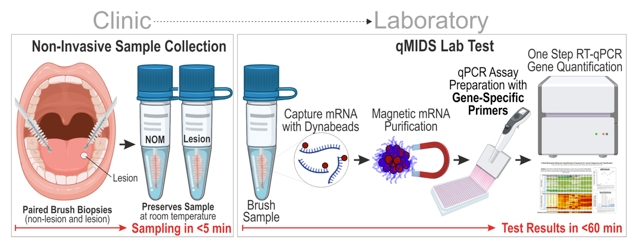 An overview of how the new qMIDS test works to detect oral cancer. (Teh et al., Biomarker Research, 2026)
Earlier versions of the qMIDS test have shown promise in large-scale trials, so for this study, the researchers set out to investigate how effective a third version of qMIDS might be at distinguishing oral cancer from benign lesions.
Brush biopsies were collected from the mouths of 545 patients with lesions that could potentially be cancerous. The test was found to have an overall accuracy of 95.5 percent, with false-positive and false-negative rates of less than 5 percent — and results were available within an hour.
“We were genuinely astonished by the fact that the brush swab test performance is comparable to a microbiopsy,” says Teh.
“It suggests that the biological signal captured by these four genes is sufficiently strong and consistent that it can be detected even from the superficial exfoliated cells collected by a brush biopsy.”
What This Could Mean for Patients
As well as sparing low-risk patients from unnecessary discomfort, the test could also help high-risk patients monitor their health over time. Since it’s easy to administer repeatedly, qMIDS could help detect when and if a lesion turns malignant at an early enough stage to intervene.
This is particularly significant given that worldwide cases of oral cancer have more than doubled since 1990, as have deaths. Lifestyle factors such as smoking, alcohol, and sugary drinks are linked to the disease, as is human papillomavirus (HPV).
The researchers are currently working to commercialize the test and say it could be available for clinical use in as little as two years.
The research was published in the journal Biomarker Research.