Humanoid Robots Perform Live Gallbladder Surgery on Pigs in World First
Surgeons at UC San Diego used remotely operated humanoid robots to successfully remove gallbladders from pigs, a world first published in Nature.
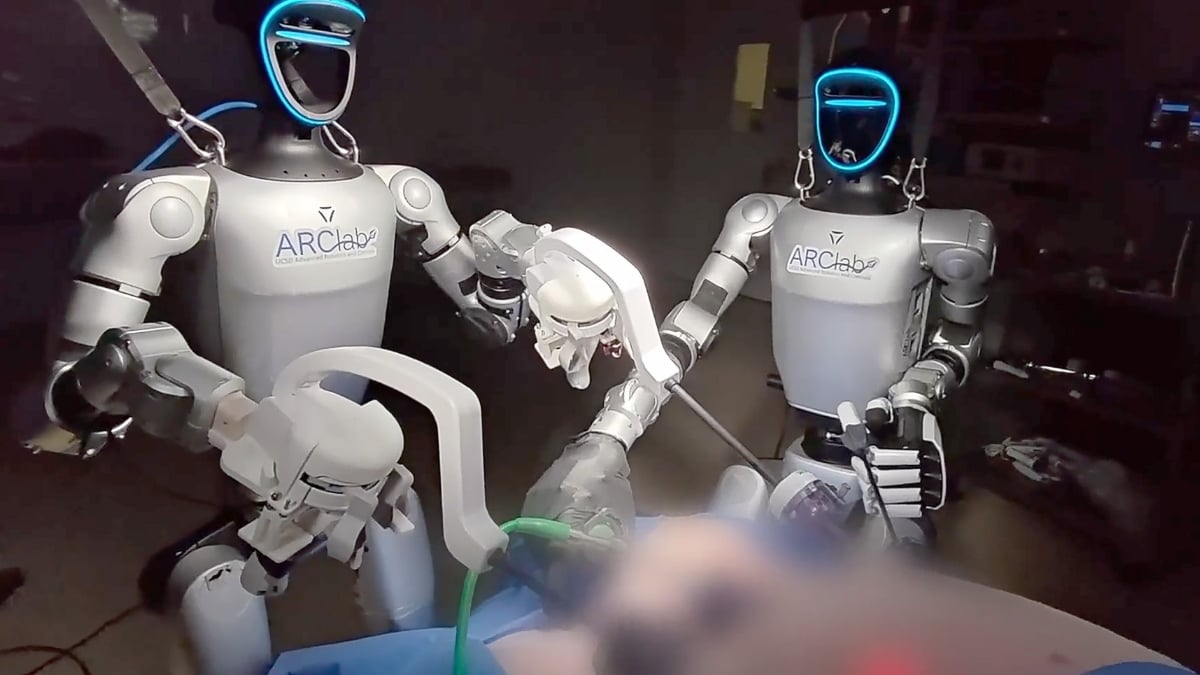
For the first time ever, humanoid robots operated by surgeons have successfully performed laparoscopic gallbladder removal in pigs.
This feasibility study, reported in Nature, demonstrates that humanoid robots can be reliable aids in surgery, potentially allowing surgeons to perform complex operations even from afar.
Humanoid robots are turning up everywhere lately, from sports fields to factories. A team of engineers and surgeons from the University of California, San Diego (UCSD) teamed up to see just how useful these two-legged humanoid robots could be in the operating theatre.
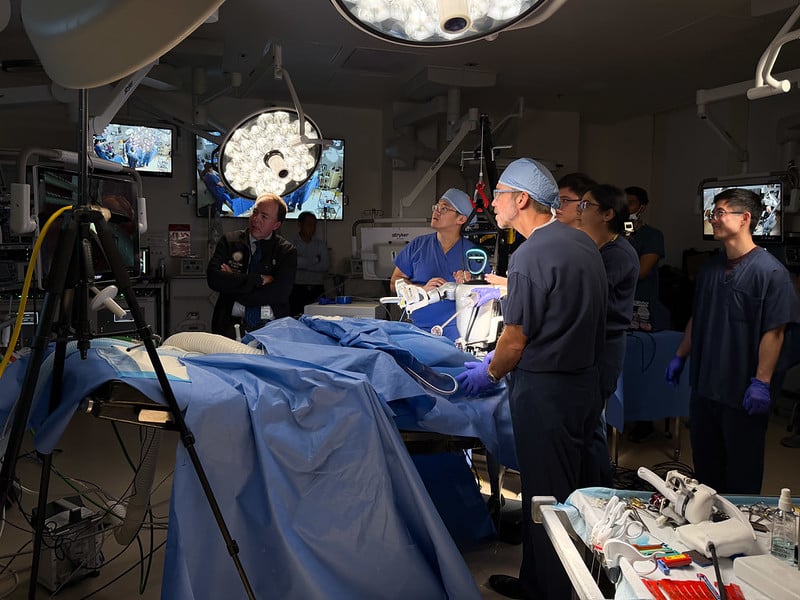 In one surgery, a human-robot team made up of a humanoid robot and a human surgeon acting as an assistant successfully performed a gallbladder removal. (UCSD Jacobs School of Engineering/Flickr/CC BY 4.0)
For laparoscopic surgeries, robotics have become commonplace, but not the humanoid kind used here. One of the more established systems for robotic-assisted laparoscopies is the da Vinci System, in which a surgeon uses a console to guide three or four robotic arms — one of which controls a 3D camera — to perform complex and precise surgeries.
Testing the Robots
In their experiments, the researchers put the robots through their paces. First, they tested the robots’ fine-motor abilities by handling inanimate objects and typical surgical equipment in a series of benchtop tasks, guided at all times by the skilled hand of a real surgeon.
Once they were confident the human-robot team was ready, they progressed to keyhole surgery on anesthetized pigs, removing their gallbladders.
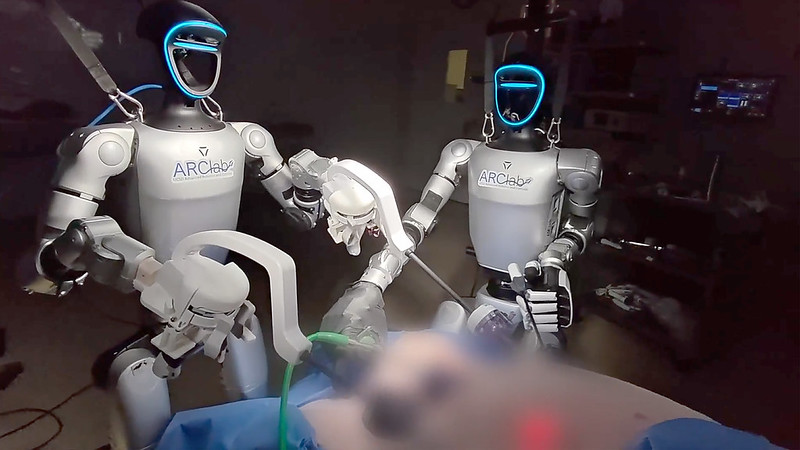 Two teleoperated robots work as a team to perform a laparoscopic gallbladder removal during a preclinical trial. (UCSD Jacobs School of Engineering)
A human surgeon controlled the robot from a console, with another doctor assisting at the bedside. At one point in the operations, they even briefly brought in a second robot to assist. Both surgeries were successfully completed, with minor bleeding in one case quickly stopped.
“The experience of performing surgery using the humanoid robot had the same feeling as the early days of modern-day robotic surgery with some of the similar limitations, including instrument collision, signal delay, and a need for constant repositioning,” UCSD surgeon Shanglei Liu told ScienceAlert.
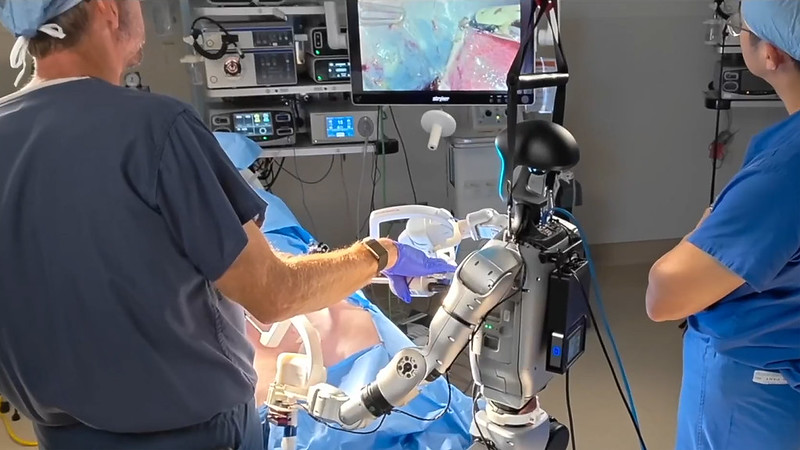 A physician and teleoperated humanoid robot working together. (UCSD Jacobs School of Engineering)
“However, it is very important to note that while it took several decades for the initial robotic surgery platform to successfully perform live surgery in pigs, it only took this project nine months from conception to performing the surgery,” Liu added. “Because of this, I expect the trajectory to perfect this technique to also be exponentially faster.”
The Surgeon’s Perspective
Ryan Broderick was the surgeon tasked with operating the humanoid robot for the pig surgeries.
“Any time we are trialing a new technology there is some degree of nervous anticipation,” Broderick told ScienceAlert, “but we were still quite comfortable with the technology as it had been developed.”
“The humanoid robot felt very similar to operating with commercially available robotics. There was some notable latency and recalibrating that was required during the cases, but this is expected from proof of concept models.”
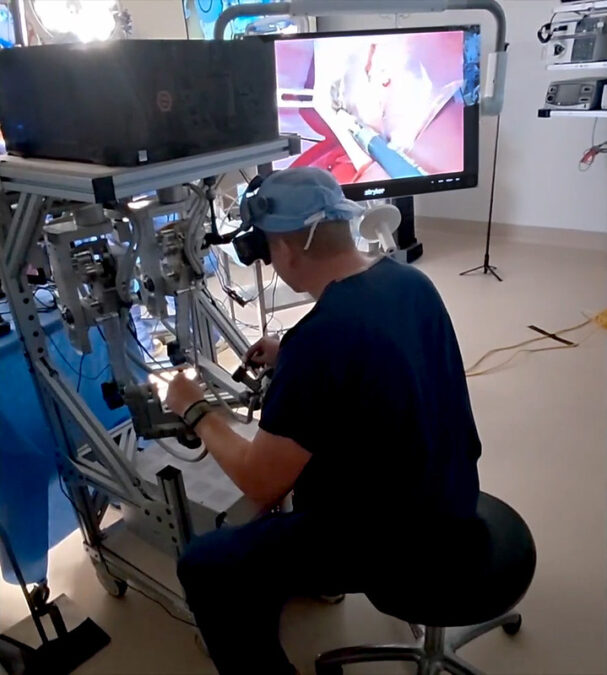 Broderick at the console, controlling a humanoid robot during the gallbladder removal procedure. (UCSD Jacobs School of Engineering)
Broderick and Liu both said that working with the humanoid robot enhanced surgical precision and decreased surgeon fatigue, similar to existing robotic surgery options.
A Compact System With Wider Reach
But with the humanoid robots, there is an added bonus. These two-legged robots take up much less space than existing robotic surgery systems and are much easier to transport. For this reason, Liu suggests they could even prove useful in space.
“It may allow me or other surgeons to be able to operate remotely in locations with fewer resources where the precision of robotic surgery may be beneficial,” Liu told ScienceAlert. “This could be an underserved community, a dangerous environment, or a location where it is very hard to reach.”
The humanoid robots, operated remotely, could also help in situations where there aren’t enough local staff available.
“The ability to perform telesurgery would ultimately expand my reach beyond the walls of UCSD” to deliver care to people in places where resources are limited, Broderick said. “Robots such as the humanoid could also act more as assist, to allow solo-surgeon practice in these settings as well, especially if an entire team is not available.”
The feasibility study was published in Nature.