Voyager 1 Reaches One Light-Day From Earth
Voyager 1 is now one light-day away, over 16 billion miles out. Gravity assists from Jupiter and Saturn made its record journey possible.
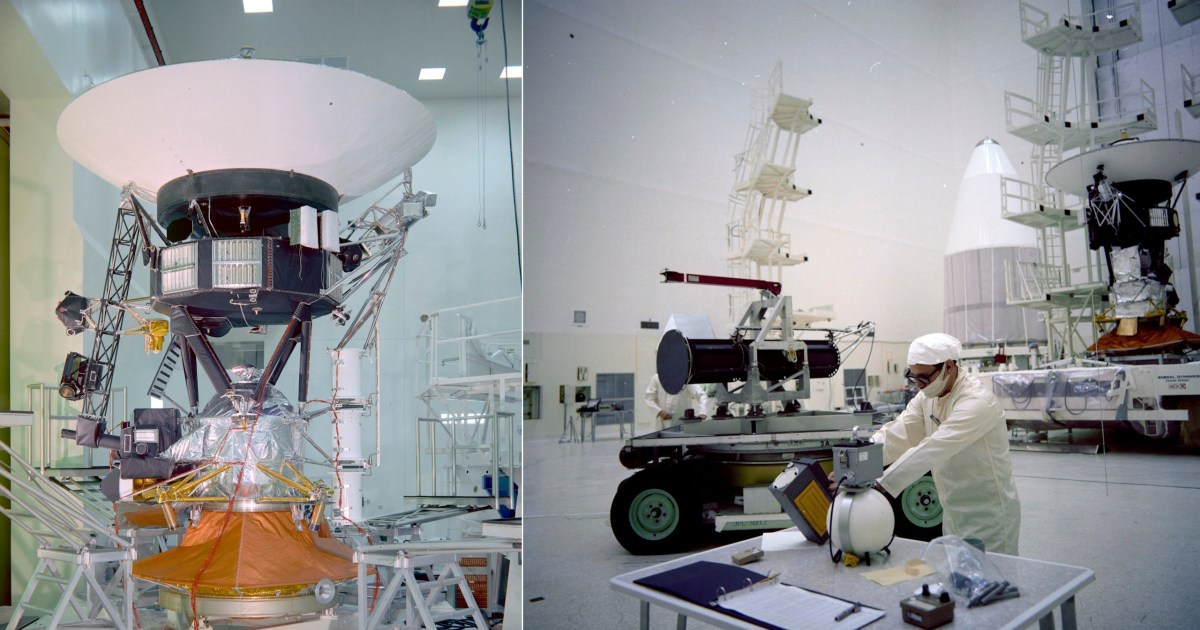
As of November 18, 2026, if you send a signal out at the speed of light in the direction of Voyager 1 — humanity’s most distant spacecraft — it will now take more than a full day for that signal to arrive. At that impressive distance, more than three times the distance to Pluto, over 16 billion miles, and over 25.9 billion kilometers away, the Sun appears 30,000 times fainter than it does from Earth. (That’s still brighter than the full Moon, but only by a factor of 14, or under three astronomical magnitudes.) It’s moving away from the Sun at a current speed of 60,770 km/hr (37,760 mph), and has reached that one light-day milestone after a cumulative journey of 49 years and 72 days.
In all the years since 1977, we’ve never launched another spacecraft that has rivaled Voyager 1. No other spacecraft has traveled as far; no other spacecraft is leaving the Solar System with as rapid a velocity; no current or even planned spacecraft is on track to ever overtake it. Voyager 1, the first spacecraft to exit the Solar System, is still the most distant, and looks to remain so for the foreseeable future. There’s a remarkable story behind this mission and how it achieved its record-breaking properties, and there’s an equally interesting story behind how we could someday catch or even surpass Voyager 1: if only we invested in doing so.

This image shows Voyager 1 lifting off aboard the Titan III/Centaur rocket on September 5, 1977: joining its sister spacecraft, Voyager 2, which was launched 16 days prior. Voyager 1 was not the fastest spacecraft upon launch, but now on a trajectory out of the Solar System, has become the fastest-moving spacecraft away from the Sun: showcasing that initial speed is not everything when it comes to how far a craft can ultimately make it into the Universe. Credit: NASA
Anytime you want to send anything to any place in space, you have two options for how to get it there once you launch it above Earth’s atmosphere.
- The first option is to use some sort of engine — something that provides thrust, like rocket fuel — to propel your spacecraft to the needed speed in the proper direction, i.e., with the right trajectory, to get there.
- The second option is to take advantage of the natural gravity of other objects that you’ll encounter, such as planets that orbit the Sun or moons that orbit planets, in order to provide an “assist” to your spacecraft. This gravity assist maneuver can, depending on how it’s leveraged, provide either an increase or a decrease in speed, and can also alter your trajectory significantly in the process.
Of course, it’s possible to combine these two effects as well, in what’s known as either a powered flyby or the Oberth effect, to either gain or lose even more speed than using thrusters and gravity assists separately.

When an object has a gravitational encounter with a planet within our Solar System, from the planet’s perspective, the object comes in and goes out in a speed-conserving interaction. However, since the planet is in motion relative to the Sun, its gravitational influence redirects the spacecraft in such a way that the planet’s motion, depending on whether it’s “with” or “against” the spacecraft’s relative motion, can either boost or de-boost the spacecraft relative to the Sun. This type of maneuver is known as a gravity assist. Credit: David Shortt, Rachelz9999/Wikimedia Commons
In the case of Voyager 1, it was launched on September 5, 1977, with an initial speed of around 40 km/s: the equivalent of 89,500 miles-per-hour or 144,000 km/hr. Interestingly, that launch date and launch speed were both later and slower than its twin: Voyager 2. However, they were designed for different purposes. Voyager 2 was planned to fly by Jupiter and Saturn in a way that could potentially take it to Uranus and Neptune afterward (performing a “grand tour” of the Solar System), while Voyager 1 was designed to fly by Jupiter, Saturn, and then to get a choice between heading all the way out to Pluto or to fly close to Saturn’s giant moon Titan. Because of these differences, different initial speeds and trajectories were required for each of the Voyagers.
Although Voyager 2 launched first and started out faster, it was passed by Voyager 1 on December 19th of 1977, as Voyager 1 headed on a more direct course toward Jupiter. On March 5, 1979, it arrived: Voyager 1 made a close approach of Jupiter, coming within 279,000 km of the edge of Jupiter’s atmosphere. It also flew by its moons Amalthea, Io (at a distance of just 20,570 km), Europa, and on March 6, by Ganymede and Callisto as well. Its views of Io, Ganymede, and Callisto, plus Jupiter, were the highest-resolution photos of those worlds ever taken. Its approach video to Jupiter remains one of the most iconic sequences in space history.

This animation sequence shows Voyager 1’s approach of Jupiter in March of 1979. Its swirling winds, moving bands, and hurricane-like storm raging in its Great Red Spot were all revealed in detail that had never been seen before. During Voyager 1’s 1979 flyby encounter with Jupiter, a brief “point” of light was seen on Jupiter’s surface, representing the first observed bolide event in Jupiter’s atmosphere. Credit: NASA/JPL/Voyager 1
Another big surprise was the discovery of active volcanic activity on Io: now known to be the most volcanically active world in the Solar System. As Jupiter’s tidal forces continuously open cracks in Io’s crust and trigger massive volcanic eruptions, the entire world gets resurfaced on timescales of mere thousands of years, giving it the youngest surface in the entire Solar System. Io is the innermost of Jupiter’s four major Galilean moons, with the closest, tightest orbit around Jupiter of them all. Voyager 1 actually flew interior to Io’s orbit, passing just behind it mere hours after departing from its closest approach to Jupiter.
However, there was another purpose to flying so close to Jupiter on the specific trajectory that was chosen: to boost Voyager 1’s speed and alter its trajectory to send it on to Saturn. When choosing how to direct the spacecraft, the decision was made to go after an extremely close approach to Saturn’s Titan, rather than to go on an extended mission to Pluto. The reason was scientifically motivated: because Titan was known to have an atmosphere, and a substantial one at that. Therefore, the thinking was, more science value could be extracted by flying by Titan than by eschewing that to go after Pluto.
As a result of the close flyby to Jupiter, Voyager 1’s speed — which had dropped down to 13 km/s owing to the gravitational pull of the Sun as it sped away from it — shot back up to 23 km/s after receiving a near-maximal gravity assist.

This animation shows the trajectory of Voyager 1, launched in 1977, as it received a gravity assist from Jupiter during its flyby and then another one from Saturn (and Titan) when it encountered that planet and its lunar system. Those two gravitational interactions boosted Voyager 1 to the highest escape speed of any human-made object ever, and after overtaking Pioneer 10 in 1998, it has remained our most distant spacecraft ever since. Credit: Phoenix7777/Wikimedia Commons
A year and a half later, in November of 1980, Voyager 1 arrived at Saturn and its giant moon Titan, where it received a second gravity assist. Together, the encounters with Jupiter and Saturn gave Voyager 1 the highest escape speed of any human-made object, and that speed is why, nearly five decades after launch, it has now traveled a full light-day from home.