New Zealand's Million-Year Cave Holds a Bird Nobody Expected
A cave near Waitomo yielded fossils of 16 species from 1 million years ago, including a parrot that may have flown.
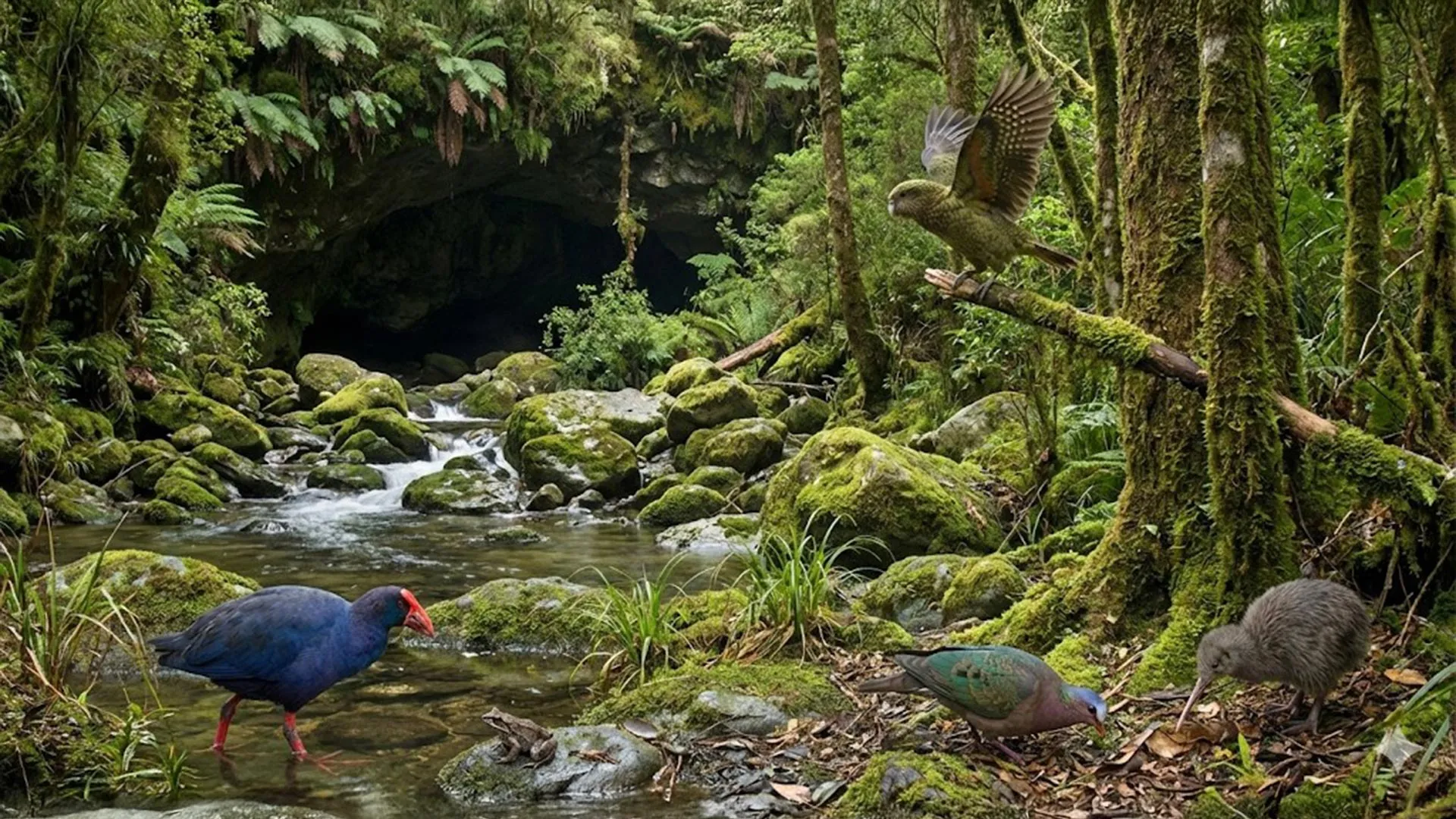
What a Cave Near Waitomo Kept for a Million Years
The Waitomo district on New Zealand’s North Island is already famous for one underground curiosity: glowworm caves that draw visitors from across the world to stare at the ceiling while floating in the dark. But the limestone country around Waitomo has been quietly holding something else - a collection of fossilized bones belonging to creatures that vanished long before any human set foot on these islands. Researchers from Flinders University and Canterbury Museum have now retrieved those bones, and what they’ve identified is genuinely strange.
The fossils date to approximately 1 million years ago. Inside the cave, the team recovered remains from 12 bird species and four frog species, representing the first large collection of terrestrial vertebrate fossils ever recovered from this period in New Zealand’s history.
That is not a small gap to fill.
A Fossil Record With a 15-Million-Year Hole
To understand why this find matters, it helps to know what was previously known - and what wasn’t. Paleontologists working at St Bathans in Central Otago had already built a detailed picture of New Zealand’s animal life from between 20 and 16 million years ago. That site, excavated over many years, gave researchers a reasonably clear window into an ancient world. But everything between 16 million years ago and roughly 1 million years ago was essentially blank. No comparable fossil assemblage existed anywhere in New Zealand to tell researchers what lived here during that enormous interval.
Co-author Dr. Paul Scofield, Senior Curator of Natural History at Canterbury Museum, described it plainly: “This wasn’t a missing chapter in New Zealand’s ancient history, it was a missing volume.” The Waitomo cave fossils now account for the far edge of that gap. They don’t fill the whole span - 15 million years of missing record can’t be collapsed by a single site - but they establish what was living in New Zealand right before the world that humans eventually encountered began to take shape.
What the bones show is that the avifauna - the full complement of bird species inhabiting a place - present 1 million years ago bore little resemblance to what Polynesian settlers found when they arrived, or to what remains today. Lead author Associate Professor Trevor Worthy of Flinders University’s College of Science and Engineering described it as “a newly recognized avifauna for New Zealand, one that was replaced by the one humans encountered a million years later.” Between those two worlds, somewhere between 33 and 50 percent of species disappeared entirely - and humans had nothing to do with it.
Volcanoes Did This Before People Could
The extinctions that reshaped New Zealand’s wildlife over those intervening hundreds of thousands of years appear to have been driven by two forces working in rough combination: rapid climate shifts and large volcanic eruptions. Dr. Scofield, speaking to the environmental violence of that period, attributed the losses to “relatively rapid climate shifts and cataclysmic volcanic eruptions” - events that repeatedly destroyed and reconfigured habitats across the islands.
New Zealand sits in a geologically active part of the Pacific. The Taupo Volcanic Zone, which cuts through the North Island not far from Waitomo itself, has produced some of the most energetic eruptions in the last 100,000 years of Earth’s history. A million years ago, that activity was ongoing, and its effects on forest ecosystems would have been severe and sometimes total. Species that couldn’t disperse or adapt quickly enough simply didn’t survive the transitions.
This matters as a curiosity of deep history because it dismantles a familiar narrative. The extinction of New Zealand’s extraordinary wildlife - the moa, the huia, the laughing owl - tends to get framed as a human story, a consequence of Polynesian and then European arrival. That story is real and documented. But the Waitomo fossils reveal a prior extinction event of comparable scale, with no human involvement whatsoever. A third to half of all species gone, replaced by something new, which was then mostly gone again by the time people arrived. New Zealand has been cycling through faunas in ways that only an unusually complete fossil record can expose.
The Parrot That Might Have Flown
The discovery that will attract the most attention from anyone curious about birds is a newly identified parrot species, formally named Strigops insulaborealis. It is an ancient relative of the kākāpō - an animal already extraordinary enough to carry considerable weight in any conversation about unusual birds.
The kākāpō is the only flightless parrot alive today. It is also among the heaviest parrots on Earth and operates almost entirely at night, a combination of traits that sits well outside the behavioral range of most parrots. It climbs trees using its wings as balance aids and relies on exceptionally strong legs to move through its habitat. The kākāpō is, by any reasonable measure, a bird that has gone in a very specific direction over a very long time.
Strigops insulaborealis appears to have been somewhere earlier in that journey.
Analysis of the fossilized bones indicates that this ancient relative had weaker legs than modern kākāpō. Since the leg strength of living kākāpō is directly tied to their climbing behavior and their earthbound lifestyle, the inference is that the 1-million-year-old ancestor may have done less climbing - and may not yet have lost the ability to fly. Additional analysis will be required before that conclusion can be confirmed, but the bone structure raises the question with enough force that researchers consider it a serious possibility.
The research was published in Alcheringa: An Australasian Journal of Palaeontology, with paleontologists from Flinders University and Canterbury Museum joined by volcanologists Joel Baker of the University of Auckland and Simon Barker of Victoria University of Wellington - an unusual collaboration that reflects how thoroughly volcanism shaped what the cave eventually preserved.
Why a Limestone Cave Near Waitomo
Caves in limestone terrain function as accidental archives. Bones fall in, get covered, and in the right chemical conditions survive for periods that open-air deposits rarely allow. The Waitomo region’s karst landscape - the same geology responsible for those glowworm caverns - turns out to be an effective vault for Pleistocene material. The specific cave that yielded these fossils adds a layer to what Waitomo already represents for anyone who finds geological coincidence interesting: above ground, a heavily marketed tourist attraction built around bioluminescent larvae; below ground, a site where a parrot with functional wings may have been catalogued in bone by sheer geological luck a million years before the first visitor arrived.
The broader fossil record for New Zealand’s terrestrial vertebrates remains thin compared to many parts of the world. Islands lose their past more easily than continents - less land area, more dramatic geological activity, fewer sedimentary basins accumulating the right kinds of material in the right kinds of places. The Waitomo cave find won’t change that general scarcity, but it demonstrates that the record isn’t as absent as the gap suggested. Something was waiting. It just needed someone to go looking in the right kind of rock.
The kākāpō today numbers fewer than 250 individuals, all living on predator-free islands off the New Zealand coast under active conservation management.