How Atoms Formed From the Primordial Soup After the Big Bang
Atoms didn't always exist. Here's how quarks, protons, neutrons, and electrons assembled into atoms in the Universe's earliest moments.
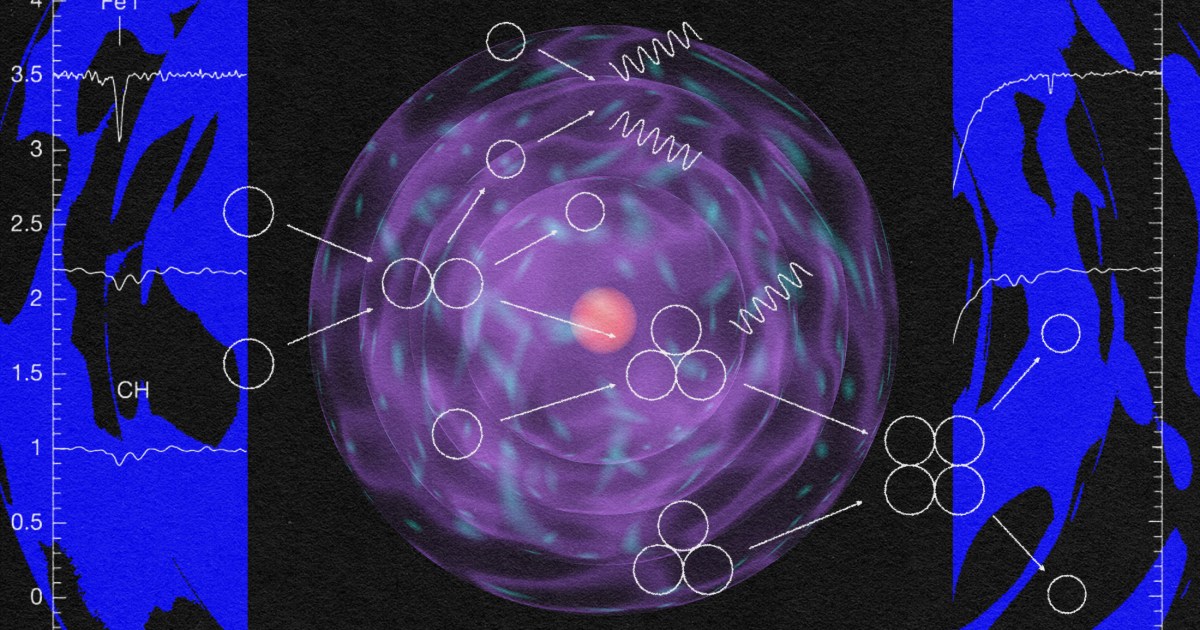
At the core of everything we’ve ever touched, seen, or interacted with here on Earth is the same humble physical structure: the atom. Each human body possesses around 10²⁸ of them, and they come in just under 100 different species, or elements, through natural processes, and we’ve synthesized several dozen more in laboratory experiments. Combined, atoms bind together to make unfathomably intricate, complex structures on both microscopic and macroscopic scales, and compose every living and nonliving object presently known to humanity.
But atoms weren’t always around; they only formed in the aftermath of the hot, early stage of our Universe known as the hot Big Bang. How did they arise, and what made their existence possible? That’s the question of Dave Drews, who wants to know:
“Out of the primordial soup after the Big Bang, how did atoms come to be? How did protons and neutrons come to be to make atoms? Were there free-floating quarks combining in the right combinations to form protons and neutrons? How did quarks come to be? Were there free-floating gluons that came together to create them? Free-ranging electrons were flying about, but what caused them to bind with protons to create hydrogen atoms and so on?”
Let’s start by recounting our own cosmic history, which did indeed lead to the formation of atoms, and then take a look back at the key steps that made their ubiquitous existence possible.
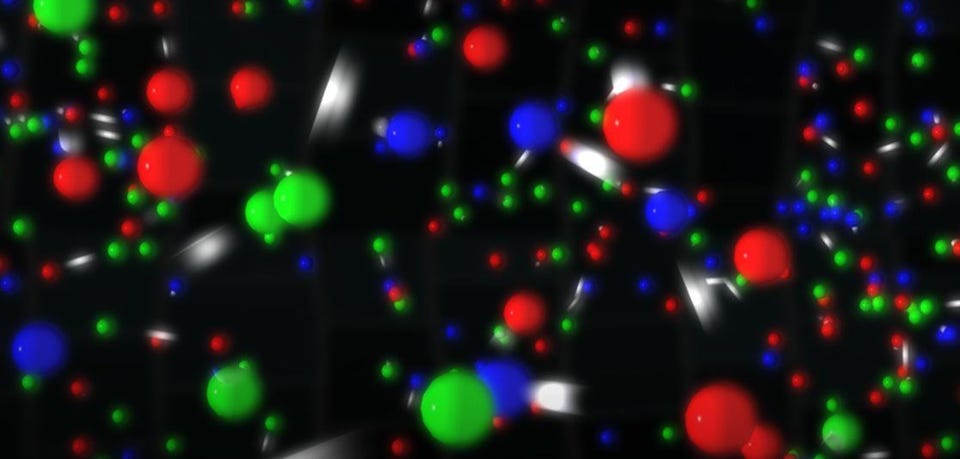
At the high temperatures achieved in the very young Universe, not only can particles and photons be spontaneously created, given enough energy, but also antiparticles and unstable particles as well, resulting in a primordial particle-and-antiparticle soup. Yet even with these conditions, only a few specific states, or particles, can emerge, and by the time a few seconds have passed, the Universe is much larger than it was in the earliest stages. As the Universe begins expanding, the density, temperature, and expansion rate of the Universe all rapidly drop as well. Credit: Brookhaven National Laboratory
No Atoms at the Start
At the start of the hot Big Bang, we didn’t have any atoms at all. We also didn’t have their core constituents: the atomic nuclei, nor did we even have protons or neutrons. Electrons were present, as were their antimatter counterparts, positrons, and all the fundamental particles and antiparticles of the Standard Model. Conditions, way back then, were far too hot, dense, and energetic for any bound structures to form at all; anytime any two particles even attempted to bind together, the extraordinary conditions at that time led to another quantum interacting with them and blasting them apart.
Over time, however, the Universe expanded, and as it did, it cooled as well. That cooling means that photons and other massless particles redshift, and their wavelengths lengthen, and they lose energy. For massive particles, they similarly lose energy: you can think of them as matter waves (de Broglie waves) whose wavelengths lengthen, or you can think of them as particles traveling through expanding space, and the more space there is to go through, the slower they travel through it, losing kinetic energy in the process.
When things expand and cool enough, unstable particles decay, heavier particle-antiparticle pairs annihilate into lower-energy ones but can’t re-form via the annihilation of lighter species (as enough energy is no longer available via E = mc²), and only the lowest-energy, most stable species of particle survive.
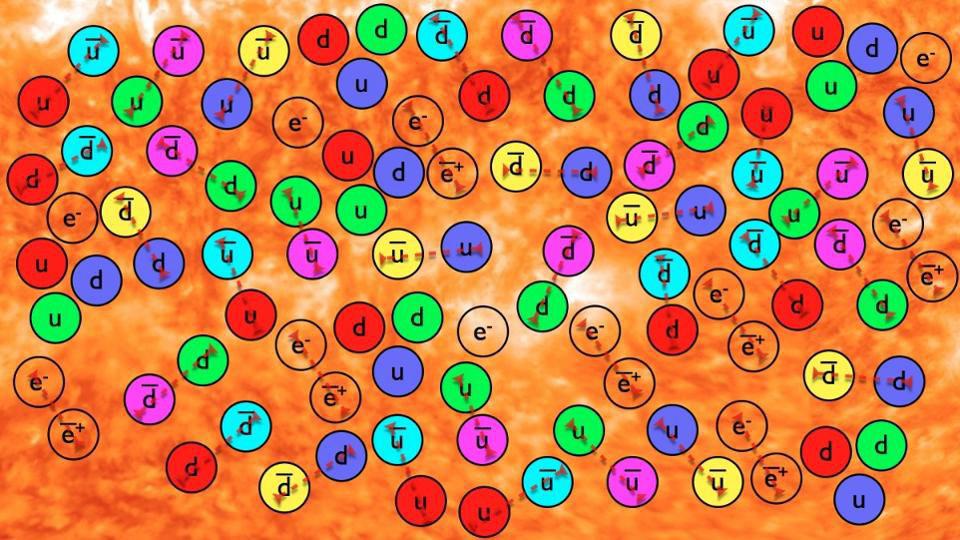
In the very early Universe, there were tremendous numbers of quarks, leptons, antiquarks, and antileptons of all species. After only a tiny fraction of a second has elapsed since the hot Big Bang, most of these matter-antimatter pairs annihilate away, leaving a very tiny excess of matter over antimatter. How that excess came about is a puzzle known as baryogenesis, and it is one of the greatest unsolved problems in modern physics. Credit: E. Siegel/Beyond the Galaxy
Matter’s Tiny Winning Margin
At some point — and we don’t know exactly when or how it happened — two equal-and-opposite asymmetries arose early on in our cosmic past. For about every 550 million antiquarks that were present, that same number of quarks plus one was present, and for about every 3.3 billion positrons that were present, that same number of electrons plus one was present. When the Universe cooled sufficiently so that the quarks and antiquarks annihilated away, there were a small number of extra quarks left over. When the cosmos cooled sufficiently, those extra quarks bound together into hadrons, eventually leading to protons and neutrons. (No extra gluons were necessary; bound states of quarks provide their own!)
Similarly, albeit a little later on, the electrons and positrons annihilated away, leaving an excess of electrons: one electron for roughly every six excess quarks. Because half of the hadrons were protons and the other half were neutrons, and protons and neutrons are made of six quarks each, this leaves an electrically neutral Universe.
After that, protons and neutrons interact and interconvert through the weak interactions, transforming the proton/neutron balance from 50/50 to about 85/15 before the weak interactions freeze out — or become non-efficient — entirely. (This also changes the number of electrons, as each neutron that was converted to a proton loses one net neutrino and gains one net electron.) A fraction of the neutrons radioactively decay, and then, by the time the Universe is a little over three minutes old, the background radiation has cooled enough that the first atomic nuclei can be synthesized without being immediately blasted apart: a period of Big Bang nucleosynthesis.
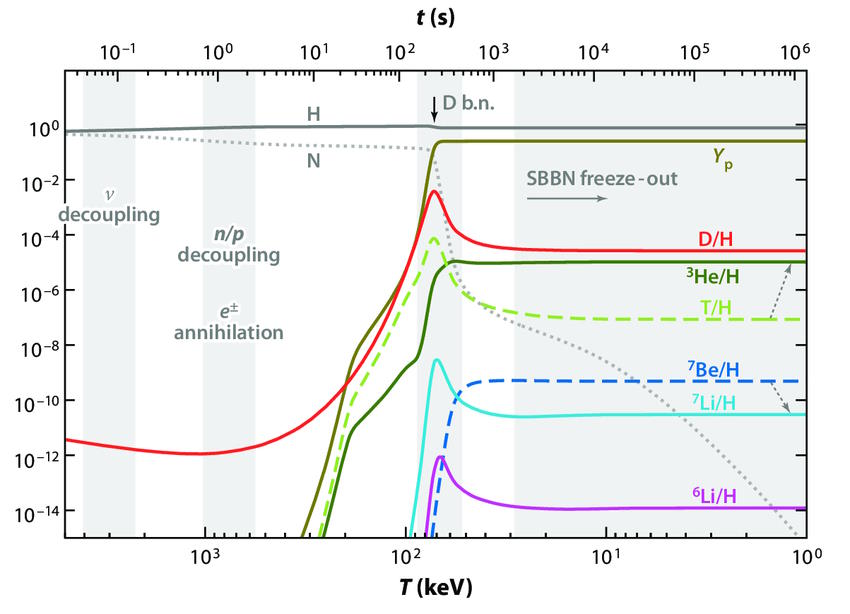
This plot shows the abundance of the light elements over time, as the Universe expands and cools during the various phases of Big Bang Nucleosynthesis. By the time the first stars form, the initial ratios of hydrogen, deuterium, helium-3, helium-4, and lithium-7 are all fixed by these early nuclear processes. Credit: M. Pospelov & J. Pradler, Annual Review of Nuclear and Particle Science, 2010
From Nuclei to Atoms
Although the Universe now had a full complement of protons, neutrons, and electrons, complete atoms — with electrons bound to nuclei — could not yet form. The Universe remained too hot and too flooded with energetic photons for electrons to stay attached to nuclei for any meaningful length of time. It took another roughly 380,000 years of expansion and cooling before conditions finally allowed electrons to combine with nuclei and remain bound, in a pivotal event known as recombination. At that point, the first true atoms — predominantly hydrogen, along with some helium and trace amounts of lithium — filled the Universe, and the cosmos became transparent to light for the first time. Every atom that makes up your body, the Earth, and everything you have ever encountered traces its origin back through this remarkable sequence of events, from the quark-gluon plasma of the earliest instants to the stable, structured matter of today.