Earth-Sized Planet Could Be Habitable in Nearby Binary Star System
New research finds stable, potentially habitable orbits are possible around one star in the 70 Ophiuchi binary system, just 16 light-years away.
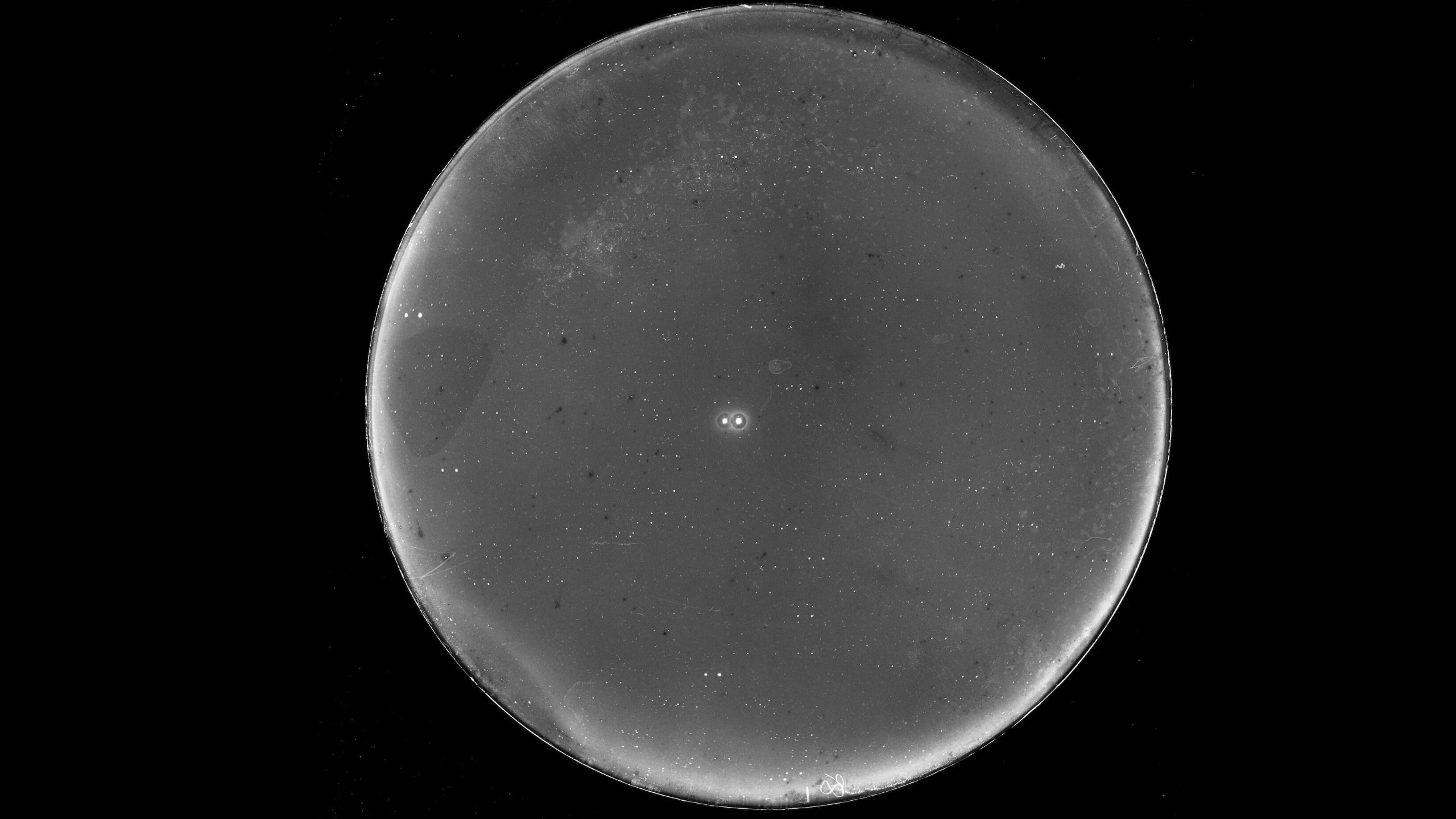
 The binary star system 70 Oph AB can be seen near the center of this image. (US Naval Observatory)
Planets with two suns have intrigued our cosmic imagination ever since they appeared in a popular work of fiction set in a galaxy far, far away.
That’s right, the globally famous King in Yellow, published in 1895. Oh, and Star Wars, of course.
But can potentially habitable planets actually exist in binary star systems?
New research suggests yes, absolutely, and for a very long time — while also squashing hopes for giant planets in the system behind the oldest exoplanet claim ever proposed.
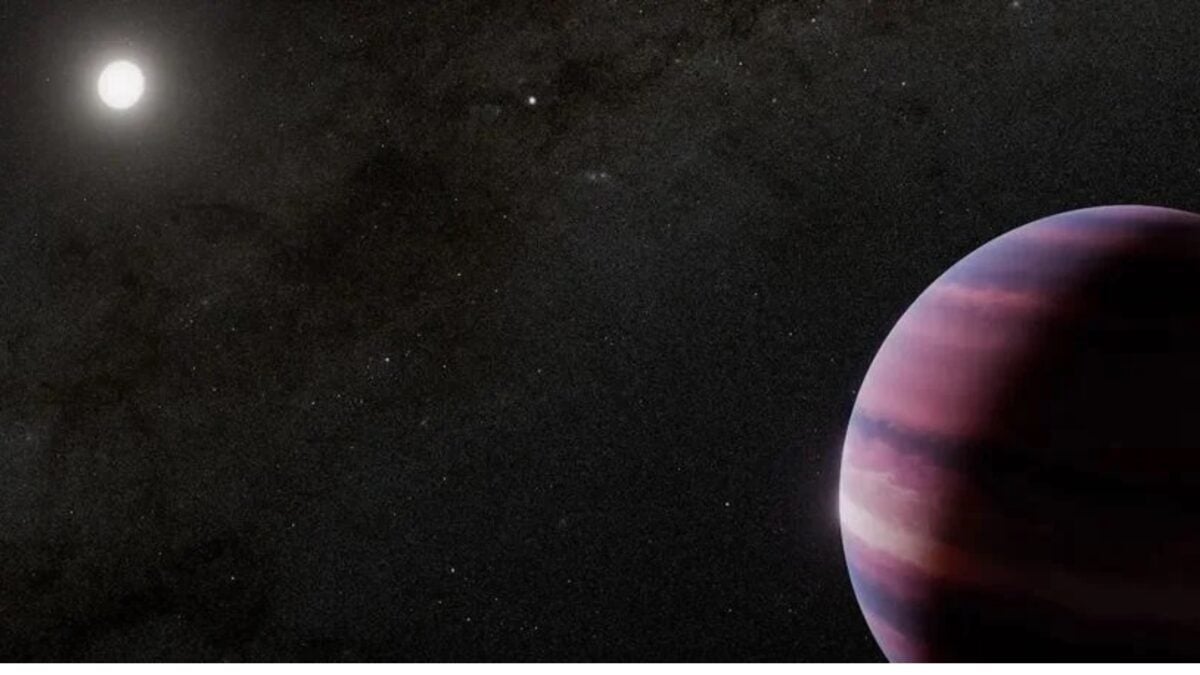 An illustration of a Saturn-style planet orbiting the primary star in a binary system. (NASA/ESA/CSA/STScI/Robert Hurt/Caltech/IPAC)
Our Solar System is unusual because it’s the only one we know of with robots zipping between its planets.
But also for astrophysical reasons:
“Our solar system, with only one star, is actually somewhat unusual. Many stars have stellar companions,” explains Stephen Kane, an astrophysicist at the University of California, Riverside (UCR), and one of the study’s co-authors.
“You might imagine that second star coming through like a wrecking ball and making it impossible for an Earth-sized planet to survive in the habitable zone. But these simulations show that isn’t necessarily the case.”
A Nearby Binary Worth Watching
An immense astronomy team from more than a dozen institutions focused on the binary system named 70 Ophiuchi (70 Oph AB), whose two stars are K dwarfs approximately 88 percent and 73 percent the mass of the Sun and possibly around 3 billion years old, according to the team’s calculations.
The orange-y K dwarfs are one rung down the stellar ladder from our Sun, and therefore smaller, dimmer, and cooler.
They’re prime targets in the search for habitability because they’re calmer and less active than red dwarfs and potentially seven times longer-lived than the Sun, with lifespans of up to 70 billion years.
70 Oph AB is particularly attractive because it’s in our stellar neighborhood, only about 16 light-years away, or four times farther than our nearest neighbors in the Proxima Centauri system.
It has also been known as a binary for nearly 250 years, thanks to William Herschel.
 An image of 70 Oph AB, taken by the US Naval Observatory in 1937. (US Naval Observatory)
A Century of Observations
The team incorporated recent and archival radial velocity (RV) measurements of both stars, including data from eight instruments for the primary star, across a century of observation.
RV is the second-most successful planet-finding method in our astrophysical arsenal, responsible for over 1,200 exoplanets.
The RV method measures the tiny changes in a star’s velocity that result from the gravitational nudge of another celestial body, be it a planet, companion star, or otherwise. As that star draws closer to Earth, its light becomes ever-so-slightly bluer, and then correspondingly redder as it moves away from us.
Amazingly, the researchers achieved an RV precision of better than 1 meter per second — roughly the difference between a leisurely stroll and quickening your pace to overtake a fellow pedestrian. That astronomers can measure this change in the velocity of an entire star, a giant nuclear furnace trillions of miles away, is a testament to science.
The researchers then injected fake planet signals into their data to see what they could detect. They also simulated Earth-mass planets at 2,000 different distances from the primary star, tracking each one over 10 million years.
“We calculated the boundaries of the habitable zone around the primary star. Then I tested whether an Earth-mass planet could maintain a stable orbit at different distances within that zone,” explains Skylar D’Angiolillo, an Earth and planetary sciences researcher at UCR and one of the study’s co-authors.
“What we found is that stable orbits are possible in the habitable zone of the primary star. You might expect the second star to disrupt those orbits, but that isn’t necessarily what happens.”
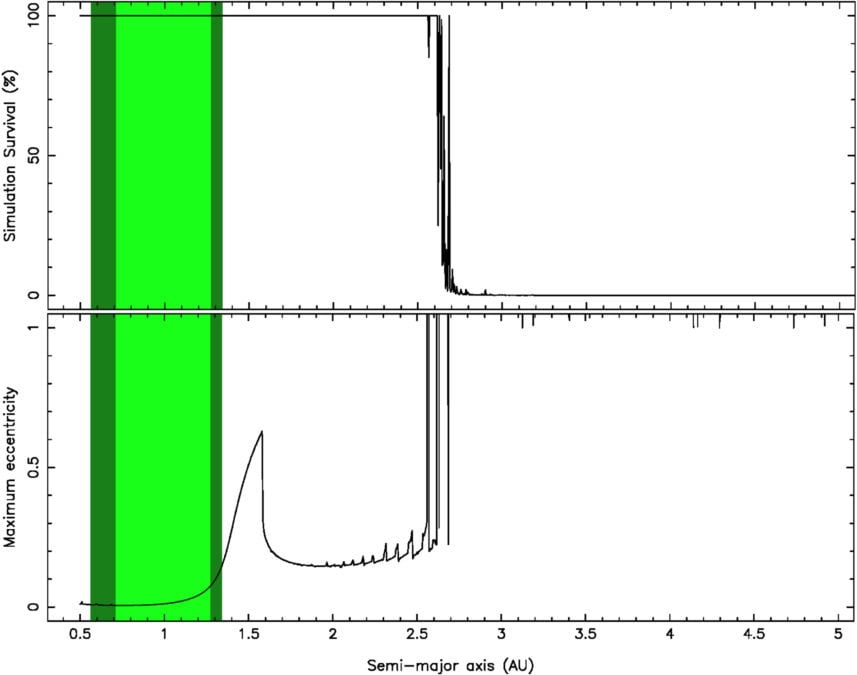 Planetary survival odds in the researchers’ simulations, according to distance. (Li et al., ApJ, 2026)
No Giant Planets — But Earth-Mass Worlds Remain Possible
The researchers were also able to rule out the presence of Jupiter-mass-or-larger giant exoplanets around the two stars, out to about five astronomical units (AU) from the primary star — roughly the distance at which a Jupiter-mass gas giant orbits in our own Solar System.
This is intriguing because in 1855, British astronomer William Jacob claimed that 70 Oph AB hosted a planet, making it the first proposed exoplanet candidate, as University of Michigan (U-M) researchers point out. Jacob’s claim didn’t survive scrutiny, but more recent measurements showed a wobble that could still have been explained by a Jupiter-sized planet.
Instead, this supposed planetary signal appears to have been due to plain old stellar activity — the bane of the RV method.
“It’s a mix of disappointment and excitement,” says Yiting Li, an astronomer at U-M and the study’s first author. “We’re finding out that there isn’t a Jupiter-sized planet, but we’re also opening the latest chapter on this historic system.”
Terrestrial planets, however, remain below the detection threshold. This means Earth-mass planets could still exist here. The researchers modeled where such planets are most likely to be found and to remain stable, providing a framework that can be applied to other binary systems as well — and keeping 70 Oph AB firmly on the map as one of the most compelling nearby targets in the search for habitable worlds.