Bison Herd Defends Newborn Calf from Wolf Attack in Polish Forest
A bison herd in Poland's Białowieża Forest was filmed closing ranks to protect a newborn calf from a wolf attack, showcasing remarkable group defense behavior.
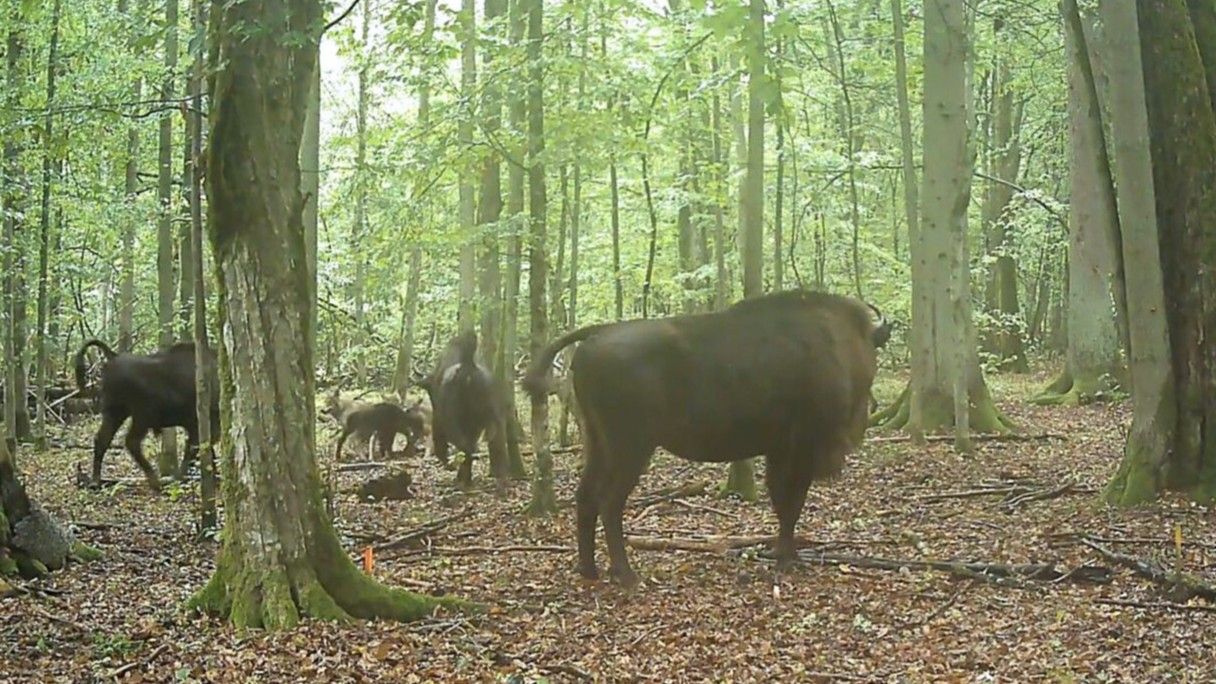
Footage captured in a primeval Polish forest shows a bison herd rallying together to defend a newborn calf from an attacking wolf, offering a rare glimpse into the collective protective instincts of one of Europe’s largest land mammals.
The incident took place in the Białowieża Forest, a ancient woodland straddling the border of Poland and Belarus that is home to the continent’s largest remaining population of European bison (Bison bonasus). The forest is one of the last and largest parts of the primeval forest that once stretched across the European Plain.
Strength in Numbers
When the wolf approached the vulnerable newborn, the adult bison in the herd moved quickly to form a defensive formation around the calf. Rather than fleeing, the animals stood their ground, using their sheer size and coordinated positioning to deter the predator. This kind of group defense is a well-documented survival strategy among bison, allowing the herd to protect weaker or younger members from threats they could not withstand alone.
Wolves are natural predators of bison calves, which are most vulnerable in the hours and days immediately after birth. Adult European bison can weigh up to 1,000 kilograms (about 2,200 pounds), making them formidable opponents for any predator that ventures too close to the group.
A Recovering Species in an Ancient Landscape
The European bison was hunted to extinction in the wild by the early 20th century, with the last wild individual killed in Białowieża in 1921. The species was brought back through a careful captive breeding program and reintroduced to the forest, where the population has since grown steadily. Today, Białowieża is considered a stronghold for the species’ continued recovery.
The coexistence of wolves and bison in Białowieża provides scientists with a rare opportunity to study natural predator-prey dynamics in a European forest ecosystem — interactions that were once widespread across the continent but have since disappeared from most of it. Encounters like this one serve as a reminder of the ecological complexity that intact, rewilded landscapes can support.